A Summarized History
General Information
It is the 8th year of the new age, After Eclipse; A.E.
Our Supreme Serani Esta has tasked me, Rytys Saevyre, to compile the most important pieces of recent history, as well as information about every known Nation, on either side of the Eclipse.
The Eclipse, The Merging and everything that led up to it
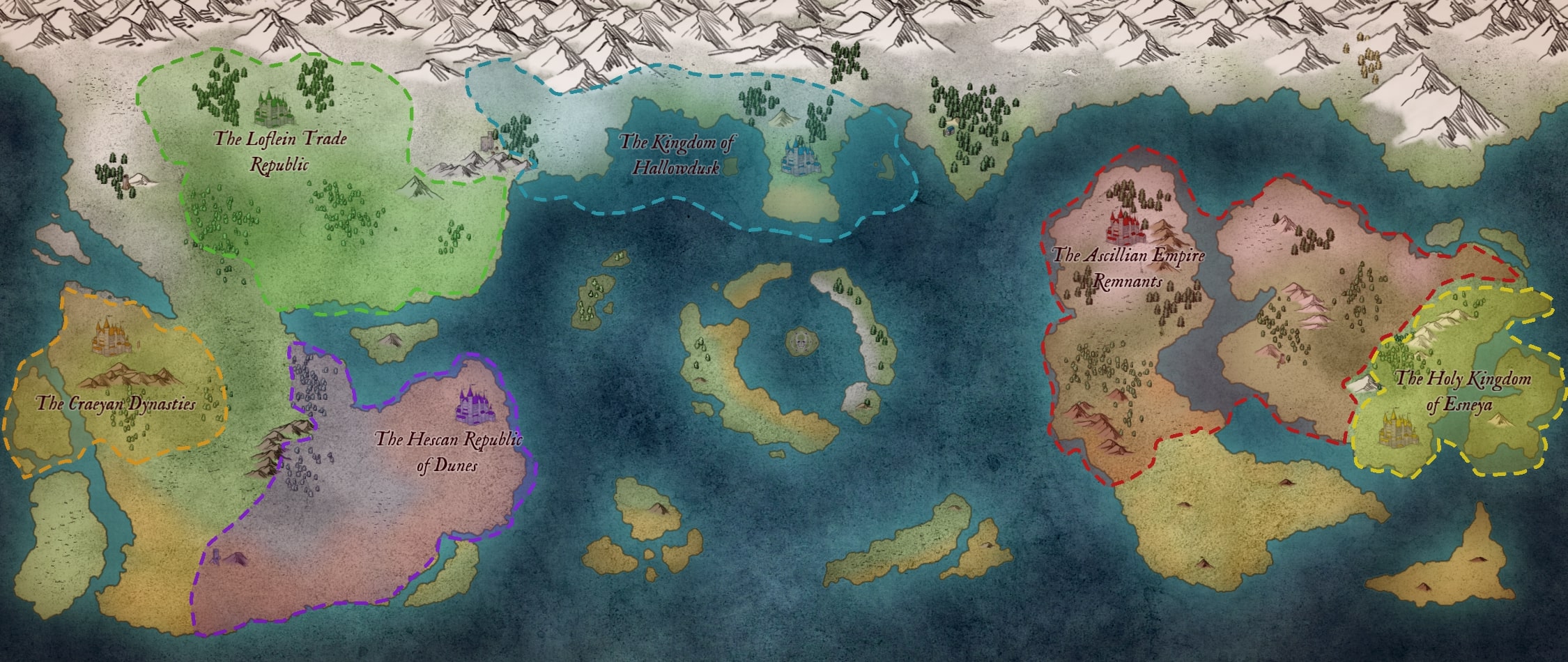
A rough map of the world from the dark side of the eclipse, In the Year 63 A.D.:
Most scholars agree that the lead up to the Eclipse began even before the year 0 A.D, as most see it as a continuation of the battle for dawn that occurred at the end of the previous age. In it, a group of adventures uncovered the plots of an ancient cult, the acolytes of annihilation, who sought to resurrect their long dead master once more.
The heroes failed to stop the resurrection, and it turned out that their master was an ancient dragon from old legends and folklore, only known as “The Dragon of Wisdom”. In those legends another Dragon is always depicted, known as “The Dragon of Power”.
The servants of Power and Wisdom fought, after the latter had turned mad. The twenty-two servants of Power were known as “The Nightbreakers”, and each of them was bestowed with great strength, and a legendary artifact known as a Primal Shard.
The servants of Wisdom, known as the Acolytes of Annihilation, were a much larger group. Only one of them was gifted with extraordinary strength, and a weapon to match the Dragons power: Eclipse.
It is said that the battle raged on for days, with the Nightbreakers only barely securing their victory, at the cost of their masters life.
A similar battle ensued at the end of the previous age.
After the Dark Resurrection, the so called “Dawnbringers” would gather their allies and fight against the Acolytes, only winning because they managed to claim eclipse and use it against their enemy, at the cost of the wielder’s life.
What precisely happened in the following 60 years is unclear, with most information either being unknown or veiled with bias. However, there are a few things that are known with utmost certainty:
-
Members of the Acolytes survived, and infiltrated powerful positions again, waiting for a Promised child that will bring ruin upon the world
-
The Dawnbringers disbanded, with most abandoning their adventuring lifestyle. Ormen continued longer than most, but eventually disappeared as well, secretly guarding that so called “Promised One” alongside an Elf named Panora, who later turned out to be serving the Acolytes
-
A group of Mercenaries called “The Band of the Lions” grew in notoriety around the year 50 A.D, starting as loyalists to the Ascillian cause, but expanding beyond their borders after killing the Emperor’s successor. In the year 60 they set their sights on The Promised One to aid in their battle against the gods.
From the year 60 to the year 63 The remaining Dawnbringers joined by new adventurers fought against the Band of the Lions and the Promised One, who eventually went mad and turned his powers on the world, fulfilling his prophecy as Hallowdusk was erased from the map.
A battle against the Promised one ensued, uniting the previously warring factions under a temporary truce. The battle cost many lives, but the Promised One was defeated. Upon his death, his weapon shattered, releasing everything that was once held captive within it, merging the two realities once more.
It wasn’t a peaceful reunion, as landmasses shattered and were pushed into one another, the climate changing drastically in some areas, and even other planes bleeding into the Mortal Realm.
The first year after the merging was chaos, as borders were redrawn, wars were fought and new lands were explored.
There are Numerous reports about people being stuck in a dream-like world before the merging, where the persons deepest wishes would be fulfilled, and biggest regrets undone. Not all people seem to remember it, and those that do report differing times they’ve spent in that world, ranging all the way from just one hour to up to a year in it. More research into this subject is required
It would be unfair to say people are still in unrest after the merging, as most have accepted what had happened, but there is a veritable lingering distrust between the Nations from the Dark Side of the Eclipse, and the ones from the other side.
Whether or not it dies down with the coming years, or it evolves into a much larger conflict is yet to be determined.
Magic & the Divine, Dragon-Marks and Dark-Vein
After the Merging, low levels of magic have become very prominent in the world. It is estimated that every third person is capable of some sort of magic. For most it only amounts to a cantrip or two, but a sizable portion of spellcasters have reached greater heights, given enough dedication or talent.
As for the divine, things have become a little more complicated.
Many more pantheons of gods have been discovered, with all of them seemingly giving strength to their followers, despite the fact that the existence of some gods and religions contradicts the existence of others.
On the topic of religions and their followers, all over the world magic has become more prominent and powerful, with the exception of healing magic. It seemed to have become rarer among people, and generally less powerful than it had been before. Resurrections have also become much more difficult, with them failing more often than not.
Another magical oddity would be the so called Dragon-Marks, appearing on the bodies of those from bloodlines whose ancestors wielded a Primal Shard. Their Blood is blessed by the Shimmering golden dragon of Power from the ancient legends, granting them extraordinary abilities which naturally put them a step above those without a mark. The abilities seem to vary from person to person, but all of them possess the ability to wield shards corresponding to their mark.
The final magical subject worth noting would be a sickness by the name of Dark-Vein
It is a magical disease which is currently untreatable by any known means. Why exactly it appears in people is uncertain, but in most cases it appears on those with higher magical powers, be it spellcasters or other magical effects such as Dragon-Marks. Alternatively, it also occasionally appears on people who have spent a significant amount of time in magically dense areas
The first noticeable symptoms are nausea, higher body temperature, and eventually paler skin with darker, more pronounced veins as the blood flowing through them turns black. Once the victims blood has turned black, they have anywhere between 3 years to 2 months to live. Victims become exhausted much more easily, have lesser control of their magic as it often goes wild. They also begin to lose track of reality, as they hear and see things that don’t exist, sometimes confusing memories for the current time.
,
Nations from the dark side
The Ascillian, Thaecean and Esneyan Realms
After spending roughly 60 years in brutal, senseless conflict, the nations seemed to have come to a sort of armistice, perhaps even peace, allowing a third nation to enter their political landscape: The Thaecea Alliance.
Created by Nobles and Generals who refused to continue the war after the Merging, they found their home in territory which previously changed ownership from one lord to another with the tides of war. They found their place as intermediaries, looking to quell the bubbling feuds between the leaders of either nation
The Ascillian War-machine did not stop though, and instead sought to conquer the territory of their new neighbors, The Naeris Crownlands and their Principality. They struck hard and fast, conquering half of their land within a year. The Nation likely would not remain if it wasn’t for the Kanaeris Principality, which struck a lukrative deal with the Empire. For further information, seek out the document on Kanaeris.
The Esneyans enjoyed peace for but a few years, before they heard of the Nine Hells bleeding into the lands on the other side of their sea. Knowing that a fight with the Fiends is inevitable, they did not wait for them to reach their shores, and instead decided to fight against the demonic incursions. Though they fought valiantly, they were pushed further and further away from land. They found that they could not defeat this enemy with their own might alone, so they sought out help from us, the Dragon Elves.
At the current point in time, we’re supporting their cause to the best of our ability, in spite of our circumstances.
The Northern Alliance
After the Eclipse, Hallowdusk as we had once known it was gone. Only the Stillmoon council remained. Following the merging, they quickly integrated the surrounding cities and states into their network, eventually managing to unite two formerly warring kingdoms under their new Alias: The Northern Alliance.
Though credit is due to the Rulers of Stillmoon, they could not have accomplished this feat without the support of Loflein, who have pledged to share their technological advancements with other alliance members, asking in turn their protection and full support in their Research of material Sciences.
Currently, under the Banner of the Northern Alliance are the following States:
-
The Stillmoon Council
-
Loflein
-
Keiva
-
The Merberg Realm
-
The Rosvik Kingdom
-
Sharia
-
Ohalle
-
The Burning Tribes
At the time, Stillmoon remains the elected leading Nation of the Northern Alliance, headed by Aleesia Emmery as voted for 3 years ago.
Loflein hasn’t changed much, despite joining the Alliance. They’ve managed to retain most of their autonomy, and have much more sway in council decisions compared to other members.
Roughly 6 years ago the Arbiter was murdered by the Raven of Loflein, who was revealed to be Emile Gariel, Husband to Saphira Gariel in the Craeyan Dynasties.
Shortly after the Arbiters death, Saphira’s brother Cindred killed the Raven and was chosen as the new Arbiter.
Besides that, Loflein has rapidly managed to build a network of railroads connecting most nations on Kamos, as well as some on it’s eastern neighbor continent. Though highly expensive, the so called lightning rails allow for rapid transport of both Goods and Persons to their many stations all throughout Kamos.
The Burning Tribes, led by a Goliath known as Moriad, the “Flamebringer”, are the most recent addition to the Alliance. Seeking to better the lives of their people, the Burning Tribes agreed to lend their military strength to the Alliance, in exchange for Resources and Knowledge.
There are four major tribes under the Burning Banner:
-
The Stjarna: Led by Nauki Stormtamer
-
The Eigiskal: Led by Asger Haldor
-
The Magnhild: Led by Pugun Dreameye
-
The Thul-Nekali: Led by Moriad “Makon” Flamebringer
Umbermore in recent years has repeatedly asked to join the Alliance, but has been rejected time and again for varying reasons.
Hesca and Craeya
Hesca has remained mostly unchanged, only their surroundings did. Many outer settlements from Setmerun have decided to join Hesca, creating the first sparks of what will undoubtedly lead to conflict in the future. They’ve also agreed to Loflein’s lightning rails passing through Hesca under the condition that they are able to use them freely as well.
Only two years prior to the writing of this document has a bridge between Hesca and the Kannaeris Principality finished construction. Titled “The Harmony Viaduct”, but referred to as the Filter by Locals, the nearly 30 Kilometers long bridge is the only land connection between Kamos and Nonera, but it also acts a toll booth for ships crossing from the south to the north.
The former King of the Hesca, later council member of the Hescan Republic Hanadur Kiman, has stepped down from his position, with Aeren Feiphel elected as the new Leader of the Republic.
The Craeyan Dynasties retained the same leadership they once had, but have now been cut off completely from the land they once neighbored. Tensions between the Dynasties are growing once more as dissatisfaction with the Leading Agidel Dynasty rises, following the bloody mage rebellion which began almost 10 years ago.
,
Nations of Kamos
Umbermore
Umbermore is a comparatively small nation to its neighbors, located on the eastern coast of Kamos, just below the Northern Reaches. The people of Umbermore are deeply religious, and as such, the leaders of their faith lead the nation as a whole. Though the Order of Embers isn’t exclusive to it, nowhere else are their followers as fanatic as they are in Umbermore. This may in part be due to the unnaturally grim atmosphere within the Nation, but we cannot draw a certain conclusion yet.
Setmerun
Setmerun is an Elven led Nation in Southern Kamos, which prides itself on its long history and culture. The Nation isn’t very welcoming to outsiders, and they commonly use slaves in order to construct massive monuments in service of their faith. The Nation is led by an ancient bloodline of Emperors, and has shown a high degree of expansionist behavior towards their neighbors.
Their military strength is extraordinary, boasting a high moral and using various beasts within their armies. Reports say that they’ve even managed to tame dragons similarly to our own, making them the only other known Nation to control them. Their Capital, Beskhe, is built around a gargantuan humanoid skeleton, which is the main subject of their worship.
Burdðrheimr
Burdðrheimr isn’t a Nation in the traditional sense, as it is more a collective of Tribes sharing a similar culture in close proximity to one another. Their land is harsh and unwelcoming, with farmlands being practically impossible to maintain. Because of this, they have developed a Raiding culture. They take from their neighbors to the south, and occasionally, further to the east. Every few years, once the tribes manage to push their differences aside, they embark on a great raid around the world. On this raid, they seek to pillage from lands they’ve never seen before, sometimes travelling for months from coast to coast.
The people of this land worship their ancestors and and a pantheon of gods, which seems to be rather warlike in their myths. Each person choosing a god from which they seek to gain blessings in their life, but occasionally asking for favours from related deities.
The people of Burdðrheimr aren’t strangers to other religions however, and they’ve made a habit of adding every deity or religion they come across to their own pantheon of gods. Most of the time, they depict the Northern Gods as superior to ones from other lands though.
The Dead Kingdom
Not much is known about the Dead Kingdom. It was once a flourishing civilization, spreading all across Kamos, but something terrible befell them which caused the downfall of their nation. Now, in what used to be the heart of their realm, the Undead roam the lands. The region is littered with ruins and monuments to long lost gods, decorated with murals giving us small glimpses into what their culture may have been like.
Their downfall may be connected to the Charred Plains, but there is little evidence to support that claim beside it’s proximity.
The Unbound Expanse
The Expanse is a gigantic stretch of land west of Setmerun, covering almost a third of the continent. It is a lawless land, with many different clans, towns and states within it. The only uniting factor for them seems to be their shared hatred for their more civilized neighbors. Otherwise, there isn’t much to connect people from one end of the Expanse to those on the other end.
Antadon
Antadon is a city state south of the Unbound expanse, Funded by Loflein to serve as a foothold in the southern parts of Kamos. People from the Unbound Expanse aren’t very fond of it, and lightning trains leading to it are often victims of attempted robberies. Antadon used to be know for its beautiful landscapes and coral reeves, which have either been harvested and shipped off to Loflein, or sectioned off as a resort for their nobility.
The Charred Plains
The Charred Plains are, as the name suggest, a large stretch of land which resembles descriptions of the elemental plane of Fire. Sources contradict each other on how exactly the land turned out as it is now, though most people believe the Charred Plains are involved in the downfall of the Dead Kingdom.
There are a few towns scattered at the border of the plains, mostly serving as resting points for people venturing into the plains. Exploring them is not advised, as the majority of people venturing into the plains do not return.
The Johrton Dynasty
The Johrton Dynasty is a Nation led by a royal bloodline of Orcs, though they may be replaced if other families prove to be stronger. The Johrton were founded by Orcs who wished to abandon their more barbaric roots and join the ranks of the more civilized Nations. This may have been in part due to Setmerun, and their neverending conquest of other races.
Though the Johrton are wary of outsiders initially, they value power and honor, and their trust can be won over following displays of the previously named traits.
Halfhome
Halfhome is a once peaceful Nation north of the Northern Alliance with an unusually warm temperature. It’s primarily inhabited by gnomes, dwarves and halflings, giving the territory its name. The people of Halfhome are strangers to war, with even the dwarves only practicing their smithing and military training as tradition. Strangely enough, none of the northern Nations from either side of the Eclipse seem to know of Halfhome.
In recent times however, they’ve began preparations for war against the Northern Alliance, as they seek to claim the resources present within their mountain. This effort is spearheaded by Loflein, and though they are at the moment seeking to arrange a trade with Halfhome, its people expect the worst as they outright refuse any cooperation with Loflein.
,
Nations of Western Nonera
Naeris and Kannaeris
The Naeris Crownlands were once the largest kingdom on Western Nonera, with a history that went back thousands of years. Eventually, they grew too large, and part of it was given away to the second son of Naeris’ royal family. From then on, The new territory was known as the Kanaeris Principality. They maintained close relations for many years, though Kannaeris had an increasing desire to split off on its own.
After the merging, half of the crownlands were conquered by Ascil, only staying afloat thanks to the Principality and the deal they struck with Ascil. Not long after, Kannaeris built the Harmony Viaduct in collaboration with Hesca, greatly increasing their income. Due to both of these factors, the Kannaeris Principality has outgrown Naeris
Thva Enyaben
Thva Enyaben, or much more commonly referred to as simply “Enya”, Is a Nation led by Wood Elves who place great value in their Sylvan Ancestry. They are led by a court of noble families who have ruled over and protected their woods for millenia. They have strict laws they impose on outsiders, but especially on the humans daring to venture into or live within their lands. Records suggest that they once were much more openly hostile to humans living in their territory, but they’ve grown to accept and live alongside them.
There isn’t much more known about the people of Enya, as they tend to keep to themselves. We have however heard that if approached correctly, they tend to be relatively welcoming and open, as long as you respect and follow their rules and customs.
Sanctuary
Much like it’s neighbour, Enya, we know very little about Sanctuary besides the fact that it serves as the home to members of many monstrous races who do not belong anywhere else. They seem to be led, or rather, guided by an elder on a floating temple by the shore to the Bronze Sea. They seem to have no interest in dealing with outsiders, and are generally rather peaceful, but they’ve shown a willingness and capacity to defend themselves in around 7 A.E. against an Ascillian general and his men who ventured too deep into their woods
Epithon
Epithon is a human kingdom with an Elected King. The Kings are usually chosen based on their magical abilities, as the people of Epithon greatly value all things magical. Though Epithon has plenty of magical schools itself, most people aim to send their children to study in Epida Amini, where the most prestigious magic academy lies. Epithon also contains the highest percentage of spellcasters in the world, with just barely under half of the population being magically gifted.
The Silver Vale
The Silver Vale was once part of the Unclaimed Lands, but has recently been overtaken by Sylvallyn, or more commonly referred to as the Feywild. It used to house plenty of the smaller races, but they are slowly being driven out by the fey. The territory in some parts resembles normal grassland, while you might see a forest of mushrooms in other parts.
The Unclaimed Lands
The Unclaimed lands, as the name suggests, is a territory which belongs to no single banner. Unlike the Unbound Expanse, they are not actively fighting for their independence, because their neighbours simply do not seek to conquer them, and the various states that have attempted to rise up in them all failed in one way or another. The towns within the Unclaimed lands only fall under the same name because of their proximity to another, not because of any uniting factor.
The Hell-Steps
“It’s like Mars, but worse.” - Random Traveler
First noticed by the Dwarves of the Red Range almost 2 years after the merging, it is a portion of the Abyss which seems to have seeped into the Material Plane. Since then, it has rapidly taken over massive parts of the Unclaimed Lands. Its advance has been slowed substantially after an alliance was formed between the Holy Kingdom of Esneya, The Dwarves and the Dragon Elves at the beginning of 7 A.E.
No active portals or entrances to the abyss have been found, and yet the number of Demons doesn’t seem to decrease.
Edhellond
A Nation primarily comprised of seafaring people and aquatic races. Know to be simple and welcoming to travelers, so long as they pose no threat to their environment. They seem to have no intention of expanding and are generally friendly to all neighbors and travelers passing by. They are governed by a small council of nobles from different races within Edhellond.
They also host a considerable force as their navy is quite vast and skilled. Their ships have also been theorized to be enchanted by some unknown means, but it clearly makes them a force to reckoned with at sea.
Dwarves of the Red Range
The dwarves of the Red range once spanned the entire mountain chain if the stories are to be believed, but now they are confined to their smaller holdouts throughout the mountains. The reason for this is well documented as the creatures and forces of the underdark pushed them back and it became untenable to hold their entire nation so they retracted their borders to the stronger more capable enclaves within the red range.
The enclaves are lead by dwarven chieftains or kings, who rule the territory around their enclaves. once every few years the leaders of the enclaves meet to discuss important matters and the potential reconquest of their lost territories. The act of reclaiming their lost lands has the benefit of rediscovering all their lost wonders and knowledge.
In recent years they were also assailed by demons from the hell steps and several of the enclaves in the area went dark one after the other. the dwarves have massed their forces to protect their enclaves but with the upcoming meeting of the kings and chieftains there may be an incursion into the hell steps.
,
Nations of Eastern Nonera
The Fallen Empire
The Fallen Empire is the name given to the many nations that were once united under the once great Ridian Empire. Now what remains is half a continent stuck in a perpetual succession crisis.
Originally, The Fallen Empire was The Myridon Empire, but soon, due to marriages between different the leaders of the Empire and members of the Ridian Dynasty, The Myridon Empire soon became The Ridian Empire.
Naturally, not everyone agreed with this, even if it was a fair arrangement, simply due to line of succession and through marriage.
Nevertheless, The Ridian Empire stayed for a couple hundred years. However, in the year 805, Emperor Crusus, now more commonly referred to as Crusus the Vanquished, decided to gather a vast army, composed of troops from all over the empire. Records believe the army to have been at least 100.000 troops. With this army, he would march north to conquer The Realm of the Giants.
While short, this war would go on to be one of the bloodiest of recent times. 85 percent, if not more, of the Empire’s army were killed, or rather, slaughtered, by the giants. Most survivors would flee north, where they would create what is now known as Peia. Few survivors made it back south.
This stuck a devastating blow to the Empire, both in terms of lives lost and morale throughout the Empire, with various nations suffering great casualties due to a would-be conqueror’s failed war. The defeat suffered in the Realm of the Giants is largely regarded as the beginning of the end for The Ridian Empire.
When The Merging came about in the year 950, the landbridge connecting The Ridian Empire to what would become The Falavor Empire broke, leading Falavor to establish their independence from the Ridian Empire in the following years. In response, the Emperor marched south with his army. With both The Falavor Empire establishing independence and the Emperor moving his army south, Myridon took the chance to follow troupe and establish their independence from The Ridian Empire too.
This would start a domino effect of the now different nations of The Fallen Empire establishing independence, and would mark the beginning of the still ongoing succession crisis.
The Stormwatch Duchy
The Stormwatch Duchy is one of the oldest regions in The Fallen Empire, and as such, have always been fiercely loyal towards The Ridian Empire. This means that even now, after the succession crisis started, they side with The Ridian Empire Remnants to protect their Liege Lord.
The Duchy itself is one of the nations to have seen the most fighting throughout the years. In the days of The Empire, they were the main front against The Latien Confederacy, and in recent years in the succession crisis, they’ve fought against Liberty over land, which in term has led them to butt head with the Giants of the Realm at times, although the conflicts where Giants got involved were always shortlived.
This almost constant warfare has led The Stormwatch Duchy to be a very militaristic people, whose culture is a very warlike one, and many of the most experienced soldiers and general hail from the Duchy for this exact reason.
The Stormwatch Duchy also have several famous armies under them. The two most famous are as follows:
The Bloodsworn, who got their name as they are regarded as a symbol of the loyalty that the Duchy has to The Ridian Empire, and its line of Emperors.
The Wavebreakers, often regarded as the most notable army within The Fallen Empire, and one of the most famous armies in Vallyn overall. These watch the east against invasions from The Latien Confederacy or Liberty, and have the most experienced men in the Stormwatch Military. They are also led by the renowned Belldam Bhaston, who has led them to many victories, casting the Duchy’s enemies into the waves once more.
The Myridon Dynasty
The Myridon Dynasty was where The Fallen Empire originated all those centuries ago, and was what the Empire was originally called, The Myrian Empire. After The Falavor Empire split off, The Myridon Dynasty were the first to initiate the splliting of The Ridian Empire, and tried to reclaim the Empire in their own name.
They are currently seen as the strongest contender in the succession crisis, and are actively fighting, with The Caldian States being the nation the biggest conflicts take place in currently. Along with fighting in the succession crisis, they are trying to sway The Unarith Duchy to their side to oppose Rea Eloras.
They are also seen as the cultural origin of The Fallen Empire as a whole, and as such, their cultural values have bled into other parts of the Empire over the centuries.
The Caldian States
The Caldian states is the most decentralized nation in the entirity of The Fallen Empire. They don’t have anything really resembling a governing body, but are united under the common goal to protect what they regard as their territory from any would-be invaders.
When there are no outside conflicts, The Caldian States are usually at each others throats, but will unite as soon as outside danger arises, and have recently done so to fight The Myridon Dynasty.
They are very much a seafaring nation, with a majority of the population working some kind of jobs relating to or at sea. Many independent sailors also make their living here.
The Unarith Duchy
After the succession crisis started, and the nations broke free, many nations still butted heads. Two of these were The Myridon Dynasty and Rea Eloras. To stop the conflict before it got too large, The Unarith Duchy was made as a compromise between the two nations. As a product of the union, The Unarith Duchy now has a population with equal parts elves, half-elves and humans.
The Unarith Duchy is currently neutral in the succession crisis, and have good relations with the Dwarves of the Red Range. And even though they are one of weakest nations in The Fallen Empire, they hold an incredible sway over other nations, The Myridon Dynasty and Rea Eloras in particular, in large parts due to their strategic location and access to dwarven equipment.
This means that many parts of The Fallen Empire now influence, or at least try to influence The Unarith Duchy to get the nation’s support.
Myria
Myria is the symbolic capital of The Fallen Empire, and is also known as the “Seat of the Empire”. It is currently ruled by Emperor Liodes, cousin to Emperor Metilles of The Ridian Empire Remnants.
The nation itself is essentially one gigantic city. One of the wonders of the world, The Myrian Wall stands to the west of the city, protecting it.
With the support of The Himari Kingdom to the south, Myria holds one of the strongest positions in The Fallen Empire currently.
It is also widely regarded that whoever holds the throne in Myria has the main symbol of legitimacy in The Fallen Empire, which has led to more tension between believers of Emperor Liodes’ claim versus believers of Emperor Metilles’ claim.
West of the Myrian Wall there is still city, although not as dense as the city east of the wall. Further out, the landscape is covered by farmland.
Rea Eloras
Rea Eloras is the only nation from the remnants of the old empire to not have a population with a human majority. A large majority of the people living in Rea Eloras are elves, High Elves to be exact.
The nation itself has roots going back for multiple millenia, only being conquered by The Myridon Empire 700 years ago. Some of the oldest elves alive still remember a time before Rea Eloras was conquered. When the then Ridian Empire started falling apart after The Merging, these elders, who had seen their Kingdom in a time where it was free, wanted to go back to the time before they were conquered. And so, they guided the young King Misaneo to grasp the opportunity for independence once more. And so they did, creating a once again free Rea Eloras.
As with The Myridon Dynasty, Rea Eloras wants The Unarith Duchy on their side, both due to the strategic advantages the Duchy has, but also due to the large population of High Elves still located in the Duchy.
The Himari Kingdom
Out of all the nations after the dissolution of the Empire, The Himari Kingdom is the most stable one. This is due to the Kingdom having as central a location as they do. The Kingdom has almost all necessary resources themselves, and were very central to the integrity of the Empire before its fall, and thus had all the necessasary infrastructure needed to keep themselves stable. The Himari Kingdom is also generally the best piece of land, and most food production for the entire Empire comes from The Himari Kingdom, which is another fact vital to its stability.
They currently ally themselves with Myria, and it is due to the Kingdom’s stability that the Myria now holds one of the strongest positions in The Fallen Empire. Due to this alliance, The Himari Kingdom also act as a sort of buffer between The Myridon Dynasty and Myria, both geographically and fundamentally to the Empire.
The Ridian Empire Remnants
After the land bridge broke following The Merging, and The Falavor Empire established their independence from The Ridian Empire, Emperor Metilles went south with the Royal army numbering almost 30.000 men to retake the Falavor empire, and was preparing to take his men over the ocean when the Myridon and subsequently Himari and Myria broke off from the empire.
The nearby lands where the emperor had stationed troops stayed loyal out of fear or love for Metilles, however the territories directly under Metilles’ command is arid, broken and infertile after the cataclysmic event 8 years prior. As such the remnants have enemies on all sides and no resources to help them prevail.
Metilles holds the undying respect of his men but there is no denying that wherever he may turn there is peril, that might lead to the end of the Ridian line.
Peia
Peia came about 150 years ago, after the war Crusus the Vanquished led on the giants. When the army went north, thousands were slaughtered by the giants. Most of the survivors, known as the Lost Legion of the Empire. The Lost Legion fled, and settled at the northernmost point of the realm to escape the wrath of the giants, and in turn, the giants let them.
Peia now thrives in a coexistance with the giants. The people of Peia view the giants as protectors, as they allowed their ancestors to live. This coexistance means that they are the nation with the closest relation to the giants, if not the only.
Realm of the Giants
The Realm of the Giants is one of, if not the oldest nation on Nonera, and before Peia was settled, it was also the northernmost nation. As the name would suggest, the Realm is almost exclusively populated by the Giants and Giantkin.
The Realm of the Giants is mostly secluded, and doesn’t like direct contact with other nations, with few exceptions like Peia and Liberty. They also do not actively engage in conflicts unless forced to do so, with the most extreme example being the war Crusus the Vanquished led on them.
While other, smaller giantkin are present, the most predominant races are, written here both in their own language and their common names, Uvarjotunen/Storm Giants, Skyejotunen/Cloud Giants, Ildjotunen/Fire Giants, Isejotunen/Frost giants, and Haugjotunen/Hill Giants. The most numerous of these groups are the fire giants, whose craft rivals that of the dwarves, if not far surpasses.
The Realm operates under a special social structure to which all the giants adhere, dating back to the dawn of The Realm. It’s similar to class-based societies like our own, but much more specific, where each individual is assigned a social rank. Each giant then knows whether or not giants are inferior or superior to themselves, and no giant is equal to another giant.
Liberty
Liberty is the smallest actual nation in eastern Nonera. They are known to be a very cutthroat society, with murders and intrigue around every corner. The population of Liberty is prodominantly tieflings, and the society itself runs on a power structure between various noble families, who are also primarily tieflings.
Though they never formally declared an alliance with the Latien Confederacy, Liberty has been fighting against The Stormwatch Duchy for decades in an effort to gain more land for themselves. Their effort have only ever been partially successful, as they were consistently pushed back into their own territory by the duchy. Any further advances by the Duchy are pushed back by the Giants.
The Crowned Republic
Of all the so-called “civilised” nations on eastern Nonera, The Crowned Republic is the only to never have been conquered by both The Myridon or The Ridian Empire. Not to say that they didn’t try. Over the centuries, several conflicts, often bloody, have been had, but they’ve never achieved more than minor landgain.
This is in large part due to both The Republics heavily fortified southern and eastern borders, riddled with fortifications and several smaller outposts to mark any incoming invasion. Any invasion would also be met by The Crowned Republic’s well equipped army of heavy infantry, and with terrain that heavily favors the defending nation, with dense woods and narrow valleys between hills, invaders would be harassed by skirmishes at all times.
The Crowned Republic was once a monarchy, but over time became a constitutional monarchy, as more power went from the monarchs themselves to the actual people, as the monarchs become figureheads more than anything, and a status symbol.
The Latien Confederacy
The Latien confederacy consists of several smaller nations who all united for the purpose of defending and eventually beating the Ridian Empire. These nation vary greatly in both size and culture but had a uniting factor to keep them from fighting each other.
In the north you have the “……” who are somewhat similar to the people of the Stormwatch duchy. They are highly militant and are mostly seen as the arm of the Latien confederacy army. This gives them great sway in internal politics. The people themselves have been proven to be great friends or terrible enemies.
In the center of the island you find the more established “…..”. They stand for most of the production within the nation, and holds most of the population. They are usually seen as the face of the confederacy and most important events take place within their land. They are well established compared to their northern cousins and are very open about it, which sometimes causes conflict between the two groups.
the third and smallest group is located in the north-eastern island within the border of the Latien Confederacy. The people of “……” are very secular but provide what is asked by the confedearcy as a whole. They mostly build ships for the navy and provide for themselves through other means. Several famous explorers and adventurers come from this place as many voyages have went east from this point. Some bring rumors of another continent and others bring word of terrifying beasts never seen before.
The Latien Confederacy are not strangers to war as they have been in constant conflict with The Ridian Empire to the west for hundreds of years. Most of the fighting takes place in the Stormwatch duchy, but no permanent hold has been acquired. The Latien may win at sea but have not seen fortune favor them on land. However with the breaking of the Ridian Empire, the Latien has begun anew targeting a weakened Stormwatch duchy in hopes of finally getting a foothold on the mainland continent of Nonera
The Pirates
While not necessarily a nation, one should not forget the Pirates that roam the strait between The Ridian Empire Remnants and The Falavor Empire. Formed by defecting admirals from the both sides of the strait, and other already existing organizations through the region, the pirates are becoming an ever-growing problem, seeing opportunity in the chaos created by the succession crisis.
The Pirates are mostly located in various hideouts and coves scattered throughout the shattered land bridge once connection Nonera and Aetria.
,
Nations of Aetria
Epida Amini
Epida Amini is a renowned hub of magical knowledge and study. It is frequently referred to as the magical capital of the world, and with its numerous academies and libraries, it attracts a great many scholars, mages and practioners of all manner of magic. Here, they reveal forgotten magic from ancient tomes, wile alchemical laboratories bubble with potions and elixirs. The enchantments of this city are also noticeable at every glance - the streets are paved with shimmering cobblestones, and perpetually hum with arcane energy. Luminous crystals of a wide array of colors light up the streets, while bridges made of interwoven vines and floating platforms connect the various districts.
At the center of Epida Amini lies an imposing tower known as the Arcane Nexus. It acts as the epicenter of the magical governance, and it is from here that a ruling council of powerful wizards, sorcerers, bards and the like ensure the balance and responsible use of magic within the city.
The legends say that Epida Amini was founded millennia ago by a group of powerful mages who sought a place to nurture and expand on their magical arts. They discovered a hidden ley line convergence, where the raw energy of Vallyn’s magic was at its peak. Harnessing this magical abundance, they constructed what would become the Arcane Nexus, and from that, the city would be constructed that blended both ancient architecture with the modern enchantments of todays magics.
Regnum Aurelia
Regnum Aurelia is a decently sized nation on the northern part of Aetria bordering the Nivarian empire. It has a lush nature with a warm climate, which makes the lands of Regnum Aurelia incredibly fertile, allowing for massive harvests.
The leader of Regnum Aurelia is Emperor Arenesius and is then followed by the Senate which consists of any reputable figures within Regnum Aurelia though typically nobles from families with influence in the cities of the nation.
The people of Regnum Aurelia seem to worship statues and other remnants of some previous civilization that occupied its island many centuries ago. These figures are seen as gods and the structures seen as holy sites. The structures left behind are built very intricately and work even after whatever calamity occurred.
As of recent, they have been preparing for eventual conflict with the ever-expanding Nivarian Empire, and both Emperor and people seem ready to give anything to protect their home.
The Nivarian Empire
Rising from the stark desert landscapes and formidable canyon territories, the Nivarian Empire is a beacon of ambition and tenacity. Birthed from these unforgiving lands, the Nivarians found it imperative to expand their domain, driven by the necessity of fertile soils for the sustenance of their burgeoning populace. Their unyielding drive for expansion has led to the assimilation of the verdant plains inhabited by nomadic tribes, and the annexation of a faltering nation nearby.
The Nivarian Empire rose in the remnants of the former Regnum Aurelia, following their calamity. Recently, they’ve slowly been expanding their borders, and tihs expansion has not gone unnoticed. The republics in the west cast anxious glances towards their eastern borders as the empire continues to broaden, the proximity of the Nivarians stirring diplomatic tensions and the specter of potential conflict.
Further exacerbating the geopolitical strain is the empire’s contentious relationship with Regnum Aurelia, an established realm with which they are engaged in a fierce disagreement over territorial rights and resources. Despite these challenges, the Nivarian Empire remains unwavering in its pursuit of dominance, encapsulating the spirit of a people who have morphed their modest desert nation into a force to be reckoned with.
The Republic of Satrea
The Republic of Satrea, also known as “The Luminary Republic” is the most Northwestern of the republics and acts as a guide into the Luminari Sea, called as such from the radiant light reflected upon its vast expanse from the Luminara Beacon. The Luminara Beacon is what guides travelers to the Luminari Sea. A lighthouse, which stands 217 meters tall, who’s light can be seen from anywhere in the republics and far beyond their reaches. It is recognized as one of the Pre Merging Wonders.
Satrea is one of the oldest nations in the region and has been mostly stable for hundreds of years. in recent times their peace has been disturbed by ever growing tensions with the Nomadic plains, and the ever expanding Nivarian Empire to the west. However they are confident that their neutrality and off-handedness when its comes to outside politics keeps them out of the chopping block for either threat.
The Satreans are avid scholars and the base of the Luminara Beacon is a vast library which holds wisdom and knowledge from a millennia ago. it spans many levels and is governed by a council of different experts in the various fields of study.
The Kingdom of Narhas
The Kingdom of Narhas, also known as “The Shining Throne,” is a realm of chivalry and honor. The nation is know for its grand castles, sprawling estates, and the deeply ingrained code of knighthood that is a common for the people of the nation.
Narhasians are generally known for the unwavering loyalty, and are often described as the classical knights clad in shining armor, with an appreciation for the traditional values. The rulers of the Kingdom descend from a long line of noble blood, and are taught to have a strong sense of duty, and a desire to protect their subjects.
The Kingdom celebrates martial skills, and often will hold jousting tournaments and swordsmanship contests, both as a showcase of the Kingdom’s prowess on the battlefield, but also to tighten the bond of the people.
Droeca
Droeca, a nation with verdant landscapes and breathtaking vistas is often referred to as “The Bastion of Nature.” Droecans have a deep connection with the nature that surrounds them, using its energy and resources to thrive. They possess a great knowledge of herbology, with their skilled healers known to craft remedies and medicines from the flora within the nation.
The people of Droeca are also an industrious people, who have mastered the arts of agriculture and animal husbandry. Droecans are regarded as astute farmers and herdens, who diligently tend to their lands and livestock. They also celebrate the cycles of nature with lively festivals, where they pay homage to the harvest and the changing seasons.
Kudriel
Kudriel, otherwise known as “The Jewel of the Seas,” is renowned for their seafaring traditions and vibrant maritime industry. This nation is known for its exceptional shipbuilding skills. They also have a strong affinity for exploration and trade, establishing bustling ports and coastal trading posts throughout their history.
The people of Kudriel are also known for their love of music, poetry and storytelling. The nation sports grand theaters, resonating with melodies of their unique instruments, and bard captivating audiences with tales of legendary sea creatures and epic maritime adventures.
Kudrielites, as the people are called, also hold their naval heroes in high regard, praising their bravery and skill in navigating treacherous waters and defending their shores. Oftentimes, positions of leadership are occupied by these naval heroes.
Oswen
Oswen, known as “The Mystwood Province,” is a land shrouded in mystical allure and ancient magic. Its lush and mist-laden forests house secretive socities of druids and wizards who harness the elemental forces of nature. The Oswenites are very in touch with the natural world, cultivating vibrant gardens with a variety of flora.
Oswen houses a deep respect for the balance between humans and the natural world and creatures that inhabit their lands. Their governance revolves around a council of wise elders, guiding the nation’s magical practices and ensuring that there is harmony within the realm.
Auonar
Auonar is located on the eastern side of the Luminari sea and is know as “The Sunlit Haven” for its many ports and cities that are seen as safe places for shelter, and its temperate climate. most of the coas that the nation has is filled with villages, towns and cities but alot of the population lives furthern inlands in either the capital, or its surrounding settlements.
Auonar is a principality where the figurehead of the government is the “Prince of Auonar”. This position is voted in by the noble families of the nation, and the elected prince has always seemed to come from one of these families. The prince seems to not hold any real power and when things go awry from conflict or a bad harvest, the prince always seems to be blamed and subsequently loose their head.
In recent years it seems that Auonar has devoted their people to the building of a stronger navy in either merchant ships or warships. The reason for this seems to be the rising threat of pirates north of the republics.
The Asmor Confederacy
The Asmor Confederacy, also known as “The Unified Alliance,” encompasses diverse territories. It stands as a beacon of inclusivety and cooperation, as it hosts a large variety of different races. It has humans, elves, dwarves and gnomes, and due to its reputation regarding its inclusivety, The Asmor Confederacy holds some of the highest populations of more uncommon races such as dragonborn, half-orcs, tieflings, firbolgs and such. The Confederacy is also renowned for its collective wisdom and diverse skills, ranging from masterful swordsmanship to advanced magical stuides.
The Asmorians value diplomacy, usually resolving conflicts through open dialogue and fair reflection. The capital Ardentia is a melting pot of distinct architectural styles, coming from the various vibrant cultures that thrive together in harmony within the Confederacy.
The Falavor Empire
When the Merging happened, the land bridge that had connected The Falavor Empire to The Ridian Empire broke. Following this, The Falavor Empire emerged as an independent nation, free of the influence of The Ridian Empire. It was largely due to the actions of The Falavor Empire that other nations within The Ridian Empire would declare their own independence, leading to the fall of The Empire.
The Falavor Empire is situated in a lush and fertile region, and thrives on its abundant natural resources, including vast farmlands and rich mineral deposits. The Empire is ruled by a council of noble families, and value diplomacy and economic prosperity, and therefore seek to establish strong trade networks with the neighbouring Replublics. While The Falavor Empire are not as militaristic as some of their counterparts in The Fallen Empire, they do still maintain a formidable standing army that protects its borders and helps to uphold its sovereignty.
The Anuhm Realms
The Anuhm Realms, also known as “The Enthralled Lands” and distinguished by their varied topography. The coast at the west of the Realm borders a rich jungle littered with ancient ruins of unknown origin. The jungle is punctuated by towering mountains so high that their summits are constantly covered in clouds, cleaving through the dense canopy.
Not much is known about the people living in the Anuhm Realms. Any kind of expedition ended shortly after first contact with the Tribes ruling over these lands. What little is written down are mostly myths of gods and varying stories about the origins of these people. They are only a small part, but proof enough that the Anuhm Realms promises to be rich with culture and history.
Standing out in every myth is a name that all Tribes refer to as “He who created” and “The Beginning”, a god with the name Manqu Takay. He is the unified origin for all Tribes within the Anuhm Realms and their reigning families worshipped as successors to his bloodline.
Quari
Colonial Gnomes.
The Great Nomadic Plains
The Great Nomadic Plains did not meet expeditions with the same hostility that was encountered at the Anuhm Realms. The limited amount of written knowledge about the people and the lands itself is credited to the immense size of this unclaimed territory.
Where the Plains border the Anuhm Reals the foothills of the jungle bleed into a hot desert with active migrating dunes that regularly reach heights above 50 meters and at its heart dormant relict dunes with a reduced activity due to a harder sediment and plant coverage. The harsh conditions of this environment had made it inevitable for the plants and all living beings to adapt and evolve into resilient organisms.
The Nomads living of these lands are varied in their tribes and families, the largest of them known under “Chapaq Na’an”, a semi-mobile self-sustaining caravan consisting of more than 13 families that wanders from rangeland to rangeland, whenever a season turns. These wanderings prevent the Oasis in the deserts to be overused and ensures pastures are set aside for the livestock.
Each of the families in the Chapaq Na’an has their own Chief, responsible for leading and representing their respective family. They are the mediators between the other caravans and their leaders, make crucial decisions, coordinate movement and ensure the well-being of the entire community.
Every year the caravans make their way into a hidden sacred city for a ceremony that lasts for a few days. Its name “Alqamar Wasi” translates directly into “The Mosaic Haven”, but any further detail about its location and proceedings of the ceremony were strictly prohibited from sharing with outsiders.
For travelers of the desert the Chapaq Na’an had a clear warning, though it is unknown if the ceremony in the holy city has any connection to it.
The desert holds tales of the King of Sand, a legendary figure said to be the successor of the first life. It is whispered that the King of Sand possesses the wisdom and strength of the Ancestors and ancient half gods that wandered the world before the People did. He rules over the vast desert with fairness, is a guardian to the desert’s secrets and hidden wonders and knows the shifting sands and the oases like no other. He has the ability to commune with the spirits in the desert, understands the language of the dunes and harnesses the raw power of sandstorms. He embodies the resilience and majesty of the desert, commanding respect and admiration among all who traverses its unforgiving terrain. If crossed, if the King of Sand does not see purpose in the travelers presence in the desert, if a traveler is perceived as a threat to the hidden truths of the desert the King will act and he will do his duty as the guardian that he has been since the beginning of time.
,
Nations of Nerith
Iron Gate Colony
The Iron Gate Colony is a penal colony for the countries of Western Nonera. It’s the only known place of civilization on the continent. The colony was built on the edge of the tropical land south of Nerith.
It is meant for countries to send their most dangerous criminals so that they can gather resources and information from the wild lands in the north. The Iron Gate Colony is a work camp where criminals do various menial work, collecting items to send to buyers, such as mages, nobles, and The Adventuring Guild.
The leader of the Iron Gate Colony is Warden Siziera Hardshield, A Half-Orc woman who volunteered to oversee the colony. The Adventuring Guild also has an outpost in the colony. Guildmaster Reverence, a tiefling man, directs researchers and quartermasters, who account for different supplies the scouts need on their journies.
,
Wonders of the World
Pre Merging Wonders
The Myrian Wall
The Myrian Wall, a colossal testament to both engineering prowess and imperial determination, stands as a colossal guardian to the west of Myria. Rising an imposing 300 feet tall, this architectural marvel spans the entire width of Myria, stretching from the northern to the southern border. The construction of the wall, a monumental effort that spanned 109 years, is a symbol of the empire’s commitment to safeguarding its heart, the Seat of the Emperor.
The inception of the Myrian Wall dates back to the aftermath of a minor rebellion around the year 300. In the wake of this uprising, Emperor Ildoles determined to fortify the defenses of the imperial capital and ensure the safety of the ruling seat, issued the ambitious decree for the construction of a monumental barrier. The rebellion, though minor, had exposed vulnerabilities in the security of the imperial capital, prompting the need for a formidable defense structure.
The construction of the Myrian Wall was a colossal undertaking that required the coordinated efforts of architects, engineers, and a vast labor force. The wall was designed not only for its immense height but also for its strategic placement, serving as an impenetrable barrier against external threats. The structure incorporated advanced architectural techniques, utilizing a combination of enchanted stones, formidable fortifications, and magical wards to enhance its defensive capabilities.
The construction process involved the quarrying and transportation of massive stones from distant quarries, the mastery of intricate enchantments to imbue the wall with protective magic, and the collaborative efforts of skilled craftsmen and laborers. The wall became a testament to the empire’s unity and determination to safeguard its core against any future rebellions or external invasions.
Over the course of the 109-year construction period, the Myrian Wall evolved into more than just a physical barrier. It became a symbol of the empire’s strength, resilience, and unwavering commitment to protecting its central seat of power. As each stone was meticulously placed and each magical ward enchanted, the wall bore witness to the passage of time, becoming a living testament to the empire’s history and the challenges it had faced.
The completion of the Myrian Wall marked a significant turning point in the empire’s history, instilling a sense of security and pride among its citizens. The wall not only served as a deterrent to potential adversaries but also stood as a reminder of the empire’s determination to endure and thrive. Today, as the Myrian Wall continues to stand tall and resolute, it is a silent guardian, watching over Myria and symbolizing the enduring strength of The Fallen Empire.
The Luminara Beacon
The Luminara Beacon is an ancient majestic tower that reaches a staggering height of 217 meters and can be seen all throughout the Republics. Its outer walls exhibit carvings and reliefs depicting scenes from various mythologies, historical events and fantastical creatures. They show varying degrees of erosion, offering a glimpse into its history and the passage of time.
Inside its walls, at the heart of the complex stands an enchanted hourglass. The sands within are said to have flowed continuously since the beginning of its construction 862 years ago, the only exception being during the Eclipse and the subsequent Merging.
Around the Luminara Beacon an expansive library sprawls across several halls and chambers. Towering bookshelves are carved into the stone walls of each chamber and are adorned with intricate tapestries depicting legendary tales that emit a soft, ethereal glow. The library, also known as the “Archive of Ages” is organized into sections, with vast collections of tomes, scrolls and artifacts from all corners of the realm.
The Archive of Ages is home to an Order of Lorekeepers, the Keepers of Enigma. Dedicated guardians and scholars who oversee the Archive and were entrusted with the preservation and study of ancient legends, arcane knowledge and forgotten wisdom contained within this vast collection. They possess an intimate understanding of the labyrinth-like corridors and its hidden chambers. Clad in flowing robes that are decorated with detailed patterns and symbols representing the realms of knowledge and the ranks they hold within the Order, they dedicate themselves to a tireless pursuit of knowledge and wisdom and are known for their deep reverence of learning. The Keepers are highly respected and regarded as the wise custodians of the secrets held within the Archive of Ages.
At the head of the Order stands the Grand Archon of the Ancients, the highest rank among the Keepers. He oversees the entire library, manages the collections and makes important decisions regarding acquired relics and their preservation.
The Curators of Wisdom are esteemed individuals responsible for managing specific sections of departments within the library and are directly under the command of the Grand Archon. They oversee the organization, cataloging and maintenance of the collections. Curators have a deep expertise in their respective fields and are often consulted for their scholarly insights.
Following the Curators of Wisdom are the Scribes of Secrets, skilled in transcribing and copying ancient manuscripts and texts, they meticulously handle delicate materials and ensure their safe-keeping. Scribes also assist Curators in deciphering and translating ancient languages and scripts for record into the Archives.
The Lore Wardens are the Librarians, the frontline guardians of the library. They assist visitors, provide guidance and help seekers locate specific texts and references. They also have an extensive knowledge of the library’s layout and the departments.
The Custodians of Artifacts are specialized Keepers with a focus on preserving and studying ancient relics and magical objects. They ensure the proper handling, storage and display of these precious, irreplaceable items, unlocking their hidden mysteries and safeguarding their power.
Aspiring Keepers in the early stages of their journey to wisdom are called the Initiates of Knowledge. They enter into an apprenticeship, undergoing rigorous training in various areas of ancient lore to become full-fledged members of the Order and assist higher ranking Keepers in performing research tasks.
The Luminara Beacon was partly made as a tribute to, and named after, Luminara, one of the highest ranking angels at the time of the Beacon’s creation. Luminara was known for her radiant beauty and for her brilliance on the battlefield. She was also the Exarch (Leader) of the Elysian Seraphs, Mount Celestia’s 24 solars, at the time of the Beacon’s Creation
Ardent Harmony Cathedral
The grand cathedral in the heart of Ardentia, the capital of the Asmor Confederacy, stands as a testament to the unity and diversity of the nation. Known as the “Ardent Harmony Cathedral,” this majestic structure is a harmonious blend of architectural styles, a physical representation of the various cultures that thrive within the Confederacy.
The exterior of the Ardent Harmony Cathedral is a stunning mosaic of design elements, seamlessly combining elven spires with intricate dwarven stonework. Gnomish stained glass windows depict scenes of magic and technological innovation, while human and half-orc sculptors have contributed masterpieces that adorn the outer walls.
As visitors enter the cathedral, they are greeted by a vast atrium that boasts a soaring ceiling adorned with celestial frescoes, a nod to the tiefling population’s appreciation for cosmic themes. The interior seamlessly transitions between different cultural influences, with dragonborn-inspired murals on one side and firbolg tapestries on the other.
The main altar is a masterpiece crafted by skilled artisans from each race, featuring a synthesis of magical glyphs, intricate metalwork, and gemstone inlays. The cathedral’s central nave is a marvel of engineering, with elven arches supporting a soaring ceiling adorned with dwarven chandeliers.
Throughout the Ardent Harmony Cathedral, there are dedicated spaces for meditation and prayer influenced by the diverse faiths present in the Confederacy. Each chapel reflects the unique aesthetics and symbols of the different races, providing a sacred space for individuals of every background to connect with their spiritual practices.
The Ardent Harmony Cathedral serves not only as a place of worship but also as a symbol of the Asmor Confederacy’s commitment to unity. It stands as a living testament to the idea that diverse cultures can come together to create something beautiful and harmonious, just like the nation it represents.
Arcane Nexus
The Arcane Nexus, a towering structure at the heart of Epida Amini, is the epicenter of magical governance. Its imposing exterior, adorned with shimmering runes, conceals an interior labyrinth of grand chambers and winding corridors filled with the hum of arcane energies.
At the core of the Arcane Nexus lies the Council Hall, a circular chamber adorned with a celestial map. Here, a ruling council of wizards, sorcerers, bards, and other magical practitioners convenes to ensure the responsible use of magic within the city. The council’s diverse expertise, representing various magical disciplines, leads to profound debates on ethical magic use, exploration of new mystical frontiers, and protection against magical threats.
The Council Hall’s walls house ancient tomes and artifacts, reflecting the accumulated wisdom of the city’s magical elite. From this sacred chamber, magical conduits extend throughout Epida Amini, connecting to wards, enchantments, and surveillance systems that safeguard the city.
The Arcane Nexus serves as both a symbol of magical authority and a guardian, watching over the city with a vigilant and protective gaze. Its existence and the deliberations within ensure that magic in Epida Amini is a force for the greater good, harmonizing ancient mystique with contemporary magical innovation.
Post Merging Wonders
The Harmony Viaduct
The Harmony Viaduct is the only land connection between Kamos and Nonera. It’s a bridge, spanning roughly 30 kilometers. Today, it is used as a toll booth for ships passing through. It has become an iconic symbol of technological innovation, and on top of that, a testament to the power of unity and cooperations between nations, as representatives from both Hesca and Kaennaris came together to build this monumental connection between the continents.
The harmony Viaduct is also commonly referred to as “The Filter”. It got this nickname due to its significant role in regulating trade and transportation. So the bridge acts as a literal filter, serving as a checkpoint for the passage of ships through the region. This function became particularly important when concerns arose regarding smuggling and unauthorized trade activities.
Burrowholm Ocean Fort
The Burrowholm Ocean Fort initially started as a small project started by Renaud Allard to toll incoming ships. However, when Demias Allard, Renaud’s son, took over, he decided to expand the small island by ferrying soil from the quarry on the shore. After this, he started construction on the Fort itself.
The Citadel has great marble walls with golden linings, lined with thousands of archer holes. The citadel has enough room to host 4000 men. An internal port on the eastern side of the island held a small docked fleet, ready to sail out after the massive drydock of the Fort had been opened. The fort’s treasury was also said to have held the wealth of several nations combined.
Later in life, Demias expanded the project even further, building watchtowers on each side of the fort, curving towards each side of the river opening. 36 of these were built on each side, each being able to hold 100 men, and capable of raising great chains to block incoming ships. The job of governing this enourmous fort was given to a socalled Equisitarius. The first of these was Equisitarius Fernio, and now, 200 years later, Fernio’s line still commands the fort.